This week on ‘An Interview with WiseOceans’ we spoke with our own Ashley Harding
Name: Ashley Harding
Role: Marine Biologist and Educator
Company: WiseOceans
Top Tip: Stay open-minded and persistent
Quick Fire Questions
1. What inspired you to pursue a career in marine conservation?
I grew up in South Africa, a country blessed with incredible natural beauty. From as early as I can remember, I’ve felt a deep connection to nature, animals, and the environment. The ocean, in particular, has always held a special place in my heart. I was completely captivated by it as a child- you’d have to drag me out of the water because I never wanted to leave. I loved everything about it! I spent countless hours exploring rock pools, swimming, and just being in the sea. My family really brought out this love for the Ocean in me as it would always be a place where my family gathered and had loads of fun, surfing, fishing, snorkelling and boating. The ocean became my happy place.
At the time, I didn’t really consider that my love for the sea could lead to a career. Later, when I moved to Europe, I decided to study Environmental Science, and I absolutely loved it. During my studies, I had the opportunity to do a coral restoration internship here in Seychelles, and that experience was a game-changer. I remember thinking, “Can this actually be a job?”. I was not only in the sea every day but, I was also doing something to protect and preserve what I grew up loving so much. From that moment on, I knew I wanted to focus my career on marine conservation, and I’ve been working toward that ever since.
2. What steps did you take or are you currently taking to achieve your career goals?
To work towards my career goals in marine conservation, I’ve tried to gain as much real-world experience as possible through different internships and research opportunities whilst still at university.
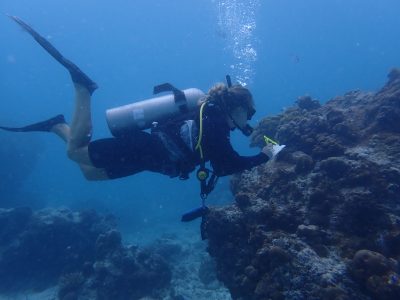
I’ve been involved in coral restoration projects in both Seychelles and Mauritius. In Seychelles, the focus was on coral gardening both in-situ and ex-situ whilst at luxury resorts, while in Mauritius, I worked on larger scale in-situ restoration techniques and community engagement. Both gave me practical experience in the water and taught me how local context can shape conservation work.
I also did a university exchange in Greece, where I focused on theoretical groundwork in marine research and monitoring. It was a great opportunity to work with scientists from around Europe and learn more about globally recognised research methodology and gave me insight into the scientific publication side of marine science.
In addition to fieldwork, I’ve completed two research theses in marine science, which helped me build a deeper understanding of the scientific side of conservation and develop skills in data analysis and academic writing.
Each step has helped me grow more confident in the path I’m on, and I’m always looking for ways to keep learning and contributing to meaningful marine conservation work.
3. How did you obtain your current position?
To be honest, job hunting after I graduated from university was really tough. It was quite demoralising at times and took around six months for things to start happening. I started out applying for marine science roles from job boards, LinkedIn and websites from a few countries around the equator, since I knew I wanted to be somewhere warm and close to the ocean. At the time, I was living in England with my parents, and after about two months of hearing nothing back, I started to feel like I might not be able to get a job in this field at all.
So, I shifted my approach. I began applying for any and all opportunities I could find worldwide, I made a real effort to use LinkedIn more actively and started really focusing on broadening my network. I reached out to a lot of people working in marine conservation-some I knew, many I didn’t- just to learn, ask questions, and put myself out there.
I had been following the WiseOceans job board for about three years by that point and knew a few people who had worked with them. I found Abbie Hine, the founder, on LinkedIn and managed to get her email address. I sent her a message directly, along with my CV, saying that I would be excited to work with WiseOceans in any capacity.
Then, almost out of nowhere, I started getting positive responses from all over! I had job offers and interviews from organisations in the Maldives, Mauritius, The Caribbean, England, and Seychelles. Around the same time, Abbie replied and asked if I’d like to interview for a role. After a few interviews with HQ, I was offered two positions on the WiseOceans team! First, as a Marine Educator at a resort in the Seychelles and as an educator on the WiseOceans Academy team whilst waiting for everything to be finalised for me to go out on-site.
I jumped at the opportunity to work with WiseOceans and turned down the other offers I had. I spent six months teaching children marine biology with the Academy before moving into my current role in Seychelles, and I’ve never been happier!
4. Which part of your job do you enjoy the most?
The part of my job I enjoy the most is definitely getting to share my passion for the ocean with others- especially when I can help people experience marine life up close, like during snorkels or educational sessions. There’s something incredibly rewarding about seeing someone’s face light up when they spot a turtle for the first time or learn something new about coral reefs.
5. Are there aspects of your position which make you feel that you are really ‘making a difference’?
Absolutely. One of the most meaningful aspects of my role is being directly involved in coral restoration. Seeing the impact of our efforts- like seeing our coral fragments starting to grow, attract marine life, or slowly rebuild degraded reef areas after outplanting- gives me a real sense of purpose. It’s rewarding to know that I’m contributing to the long-term health and resilience of our oceans.
On top of that, the educational side of my work- whether it’s with guests, students, or local communities- makes me feel like I’m planting seeds of awareness and care. When someone tells me that an experience or conversation made them want to do what I do, or learn more about marine conservation, I know that I’m helping create lasting change beyond the water.
6. What do you know now that you wish you knew when you were starting out?
Something I wish I knew when I was starting out is just how important networking and building personal connections in this field really are. Gaining experience is of course essential, but opportunities often come through the people you meet along the way- whether it’s mentors, colleagues, or others working in conservation.
I’ve learned that putting yourself out there, having conversations, and forming genuine relationships can open doors you didn’t even know existed. It’s a small and supportive community, and those personal connections can make all the difference in finding opportunities, collaborations, and continued growth.
7. Are there any skills you never thought you would need but did?
Yes- definitely public speaking and people engagement. I always imagined marine conservation would mostly involve fieldwork and data collection, but I quickly realised how important it is to communicate that science to others in a way that’s engaging and understandable.
Whether it’s leading snorkels, giving presentations, or running educational programmes, being able to connect with people- of all ages and backgrounds- has been a much bigger part of the job than I expected. It’s a skill I never thought I’d need as much as I do, but it’s one I’ve come to really value.
8. What advice would you give to budding marine conservationists?
My advice would be to stay open-minded and persistent. The field of marine conservation can be competitive and at times a bit disheartening- especially when you’re just starting out- but don’t get discouraged. Be proactive about gaining experience, even through volunteering or internships, and take every opportunity to learn, even if it’s outside your comfort zone.
Also, don’t underestimate the power of networking. Connect with people in the field, ask questions, attend events (even virtual ones), and build genuine relationships. Sometimes, opportunities come from a conversation rather than a job posting. Most importantly, keep your passion alive- because that’s what will carry you through the challenges and make your journey meaningful.
9. What is your favourite marine creature and why?
I know this is quite a generic answer but, my favourite marine creature is a dolphin. They’re actually the animal that made me fall in love with the sea in the first place. When I was younger, I used to go deep sea fishing with my dad, and dolphins would often follow our boat or jet ski, sometimes for ages. Watching them always brought me so much joy- it left a lasting impression on me and really sparked my connection to the ocean.
10. What is your most unforgettable moment in the sea?
One New Year’s Eve, the waves were glowing bright green with bioluminescence. It felt completely magical. We danced and played in the glowing water under the stars- it was like something out of a dream. That night really reminded me of how full of wonder the ocean can be.
“Connections can make all the difference in finding opportunities, collaborations, and continued growth.”
Ashley Harding
Read more An Interview Blogs here
Sign up for our Weekly free Job Alert here