Creature Feature – Gray Whale
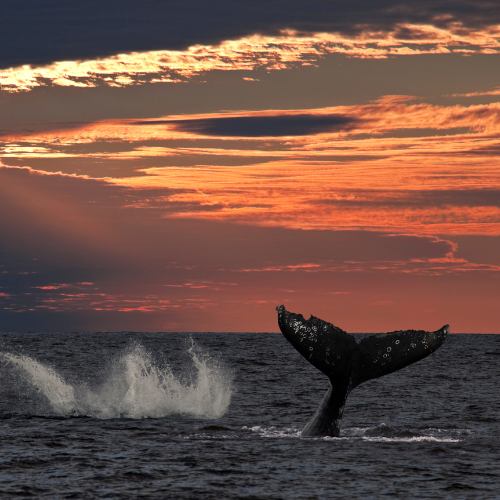
Gray whales undertake one of the longest annual migrations of any mammal on Earth, making a yearly round-trip of roughly 10,000 miles, and in some cases, up to 14,000 miles. Along this epic journey, they face numerous challenges, including vessel strikes, entanglement in fishing gear, and various human-caused disturbances.
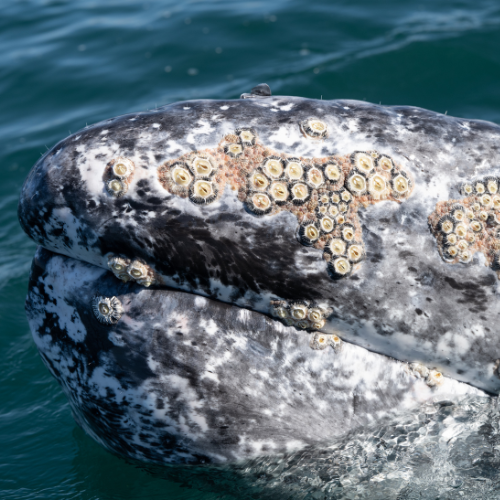
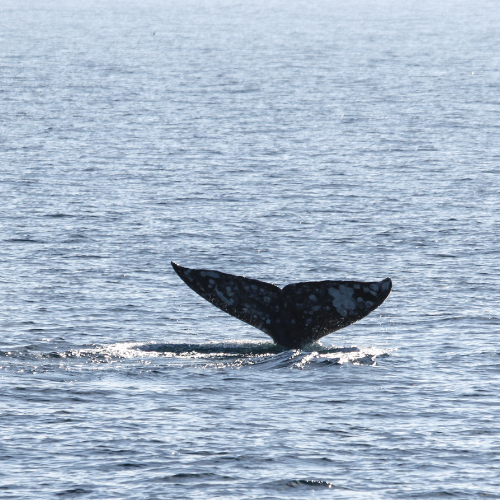
These whales are aptly named for their mottled grey colouration. They feature broad, paddle-shaped pectoral flippers with pointed tips and lack a true dorsal fin, instead displaying a prominent dorsal hump about two-thirds of the way down their back.
Newborn calves are typically a dark, smooth grey, free of barnacles, but as they mature, their colour lightens to shades of brownish grey or pale silver, often with barnacle patches that tell the story of their travels.
Taxonomy
Scientific Name: Eschrichtius robustus
Kingdom: Animalia
Phylum: Chordata
Order: Artiodactyla
Family: Eschricht
Genus: Eschrichtius
Gray Whale Fact File
 Size: Can reach lengths of up to 14 metres and weigh as much as 35 tonnes
Distribution: Primarily inhabit shallow coastal waters of the North Pacific Ocean, though they may venture into deeper areas during migration. They are commonly found along migration routes from Alaska to Baja California and near Sakhalin Island, Russia
Diet: Feed mainly on bottom-dwelling crustaceans, as well as schooling fish, shrimp, and marine worms
Behaviour: Gray whales are typically observed travelling alone or in small groups, though large aggregations may occur in feeding and breeding areas. Long-term social bonds between individuals appear to be uncommon
IUCN Status: Critically endangered